
Union Parish Criminal Court Records
A criminal court record in Union Parish begins when the criminal matter moves into court and is recorded by the Union Parish Clerk of Court for the Third Judicial District Court. It is the case-level record. It can include the charging document, arraignment minutes, pleadings, motions, hearing entries, plea records, trial minutes, sentencing minutes, fines, costs, probation terms, and post-conviction filings. It does not begin with the patrol report or booking sheet, even though those facts may explain how the case started.
Union Parish is part of the Third Judicial District Court, a district serving Lincoln and Union Parishes. The district court is the general-jurisdiction trial court for felony cases and other district-court criminal matters. Local lower courts or mayor's courts may have limited local roles, but no consolidated Union Parish lower-court search was located in the research. The full criminal case file should be separated from the narrower charge path covered in the Union Parish arrest records and court charges material.
The clerk's expungement page was one of the official sources assigned to this criminal court records page.
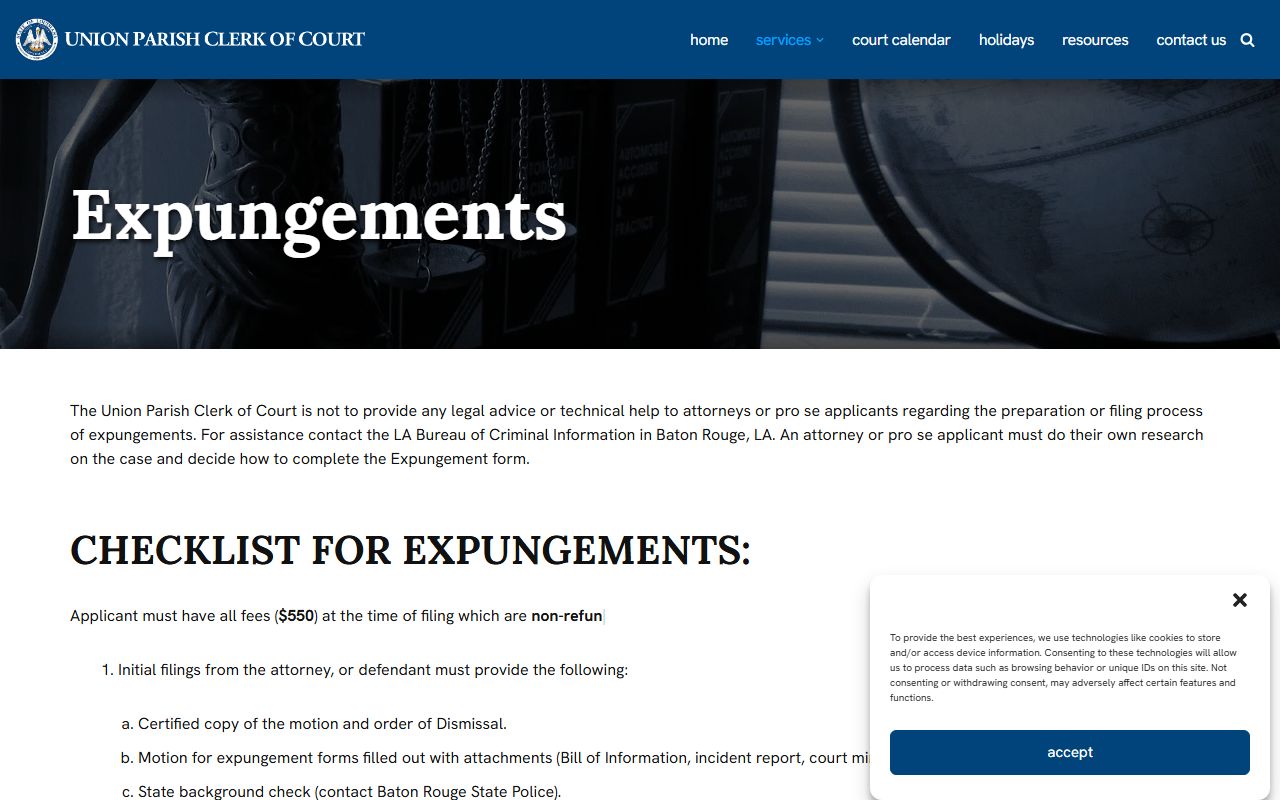
Expungement procedure matters because a criminal court record can exist in the courthouse file but be removed from ordinary public access after a qualifying order.
Search Union Parish Criminal Records
The Union Parish Clerk of Court is the local records custodian for criminal case filings. The clerk homepage advertises eSearch and subscriptions for online records and images, while the public eSearch page does not expose a complete free field list in static text. Start online when an account search is appropriate, but use the clerk directly for certified copies, older files, restricted-file questions, and case records that do not appear online.
- Confirm that the matter is a court case, not only an arrest report, jail bond question, or sheriff incident report.
- Use the clerk's eSearch access point when a subscription or account search can reach the criminal case file.
- Search or ask by defendant name, case number, approximate filing date, charge, or disposition when that information is known.
- Review the docket entries for arraignment, motions, hearings, plea, trial, disposition, sentencing, and post-conviction events.
- Request a clerk copy or certified copy when the record must be used for court, licensing, employment review, or official proof.
The Union Parish Clerk criminal services page supports the local criminal-record route, while the Third Judicial District Court calendar and rules pages help with schedule and procedure context. State prison custody, VINELink notifications, and federal PACER records are separate systems and should not be treated as Union Parish criminal court files.
Union Parish Criminal Case Flow
A criminal case file develops over time. Early entries may only show the filed charge and first setting. Later entries can show motions, continuances, plea negotiations, trial minutes, sentencing, or post-conviction filings. A charge can be amended, reduced, dismissed, or resolved by plea or verdict. That is why one docket line rarely tells the whole story.
Case flow: Charges Filed › Arraignment › Pretrial / Motions › Plea or Trial › Disposition › Sentencing
| Stage | What Happens |
|---|---|
| Charges filed | The prosecutor or grand jury route places formal allegations into the court file. |
| Arraignment | The court addresses the charge and plea, such as guilty or not guilty. |
| Pretrial / motions | Lawyers file requests, the court sets hearings, and entries may show continuances or orders. |
| Plea or trial | The case resolves by plea agreement, bench or jury trial, dismissal, or another court action. |
| Disposition | The record states how each charge ended, such as guilty, dismissed, acquitted, or nolle prosequi. |
| Sentencing | The court records sentence terms, fines, costs, restitution, probation, or other conditions after conviction. |
Union Parish Criminal Record Fields
No public sample Union Parish criminal case screen was available without subscription or login in the research file. The field table below uses the researched criminal-record fields and should be read as a case-file inventory, not a promise that a public portal displays every item. Criminal court records may also contain redactions or restricted entries.
| Field | What It Shows |
|---|---|
| Case number | The criminal case or suit number assigned by the clerk. |
| Defendant | The person charged in the court case, sometimes with limited identifying data. |
| Charging document | Complaint, bill of information, indictment, or another formal charge filing. |
| Charge list | Each alleged offense, severity, statute reference where shown, and current charge status. |
| Plea | The defendant's formal response or later plea agreement entry. |
| Motions and hearings | Requests filed by lawyers and the court settings or orders tied to them. |
| Disposition | The outcome for each charge, including dismissal, guilty plea, trial result, or nolle prosequi. |
| Sentence | Jail or prison terms, probation, fines, costs, restitution, or conditions ordered after conviction. |
| Post-conviction entries | Later motions, probation events, appeals-related filings, or expungement activity. |
Union Parish Criminal Charges
Being charged in Union Parish is not the same as being convicted. A charge is an allegation filed into the court system. A conviction is a final guilt result through a plea or verdict. Criminal court records can show charges that were reduced, amended, dismissed, or not pursued. The record should be read charge by charge, especially when a case has several counts or a plea to a lesser offense.
| Point | Charge | Conviction |
|---|---|---|
| Meaning | An accusation filed in court. | A guilt result by plea or verdict. |
| Timing | Appears near the start of the case. | Appears after plea, trial, or other final action. |
| Can change | May be amended, reduced, dismissed, or dropped. | May be followed by sentence, appeal, post-conviction filing, or eligible expungement. |
| How to read | Check the current status and later docket entries. | Check disposition and sentence details. |
Union Parish Criminal Dispositions
Disposition is the key outcome field in a criminal court record. It may show guilty, not guilty, dismissed, acquitted, nolle prosequi, or another court action. A plea entry and a disposition are related but not identical. The plea is the defendant's formal response or negotiated resolution. The disposition is the court record's way of showing how a charge ended.
Sentence reading is separate. After conviction, the case file may show jail or prison time, probation, restitution, fines, costs, supervision conditions, or post-conviction obligations. The Sheriff's Civil Office collects court fines, docket fees, and court costs for the Third District Court of Union Parish, but payment collection is not the same as the court's sentence entry. If the question is whether someone is in custody or what bond applies before release, the detention and bond channels are separate from the criminal case file.
Union Parish Sealed Criminal Records
Louisiana expungement law is important for Union Parish criminal court records. Louisiana Code of Criminal Procedure Article 971 defines expungement and explains that expunged records are removed from public access but are not necessarily destroyed for all purposes. Article 978 supplies eligibility context for certain misdemeanor and felony arrest or conviction records. A sealed file is restricted by a court order or law. An expunged file is restricted through the statutory expungement process.
| Point | Sealed | Expunged |
|---|---|---|
| Public visibility | Hidden or limited by court order, statute, or file restriction. | Removed from ordinary public access after a qualifying order. |
| Record existence | The record still exists but is not open to general public view. | The record may remain accessible to specified criminal-justice agencies or uses. |
| Union Parish action | Ask the clerk about the case and any order controlling access. | File through the proper court and follow Louisiana expungement procedure. |
| Limits | Access depends on the order and law. | Eligibility depends on charge, disposition, waiting period, prior record, and statutory rules. |
The assigned Louisiana expungement-definition source supports the public-access limit described above.
That distinction prevents an inaccurate claim that an expunged Union Parish record has been destroyed for every agency and every legal purpose.
Union Parish Criminal Access
Public access to Union Parish criminal court records is guided by Louisiana public-records law, district-court rules, clerk custody, and confidentiality limits. Court records are often public, but juvenile records, sealed records, expunged records, adoption-related material, mental-health matters, protected personal identifiers, and some sensitive law-enforcement details may be withheld or redacted. Louisiana Children's Code Article 412 makes juvenile records confidential except as authorized.
Criminal history and court case records are not the same thing. A local criminal court record shows the Union Parish case file and court outcome. A statewide or law-enforcement criminal history may include broader arrest, fingerprint, or agency data and may have separate access rules. The Louisiana Public Defender Board and Third Judicial District Public Defender context may matter for representation, but the research did not capture a verified local public defender address or phone. The Third Judicial District Attorney website was identified as the prosecuting-office source, but the manifest capture failed for that URL, so criminal charging details should be phrased from the researched role rather than from a captured division chart.
Louisiana Code of Criminal Procedure Article 978 was another assigned source for the criminal court records page.
Eligibility rules are case-specific, so the clerk can accept filings but does not decide eligibility or give legal advice.
Note: Juvenile, sealed, and expunged criminal records may be absent from public search even when a court file exists.