
Union Parish Traffic Citation Split
Traffic records in Union Parish do not flow through one universal traffic court portal. The official UPSO Civil Office research says citations issued within Union Parish by UPSO or Louisiana State Police can be paid through the Civil Office process. The same source says citation money for Farmerville, Marion, Bernice, and Junction City is not collected by UPSO. That local split controls the first step for any traffic court record search, payment, or contest decision.
For a UPSO or Louisiana State Police ticket, the Civil Office channel can handle payment instructions and online payment access. For a municipal citation, the issuing town or city court channel must be contacted instead. If a traffic matter becomes a district-court criminal or court-cost issue, Third Judicial District Court and the Clerk of Court may hold the case record. A traffic record search should therefore start with the issuing agency printed on the citation.
The State of Louisiana Union Parish local-government page is one assigned source for local-government context.
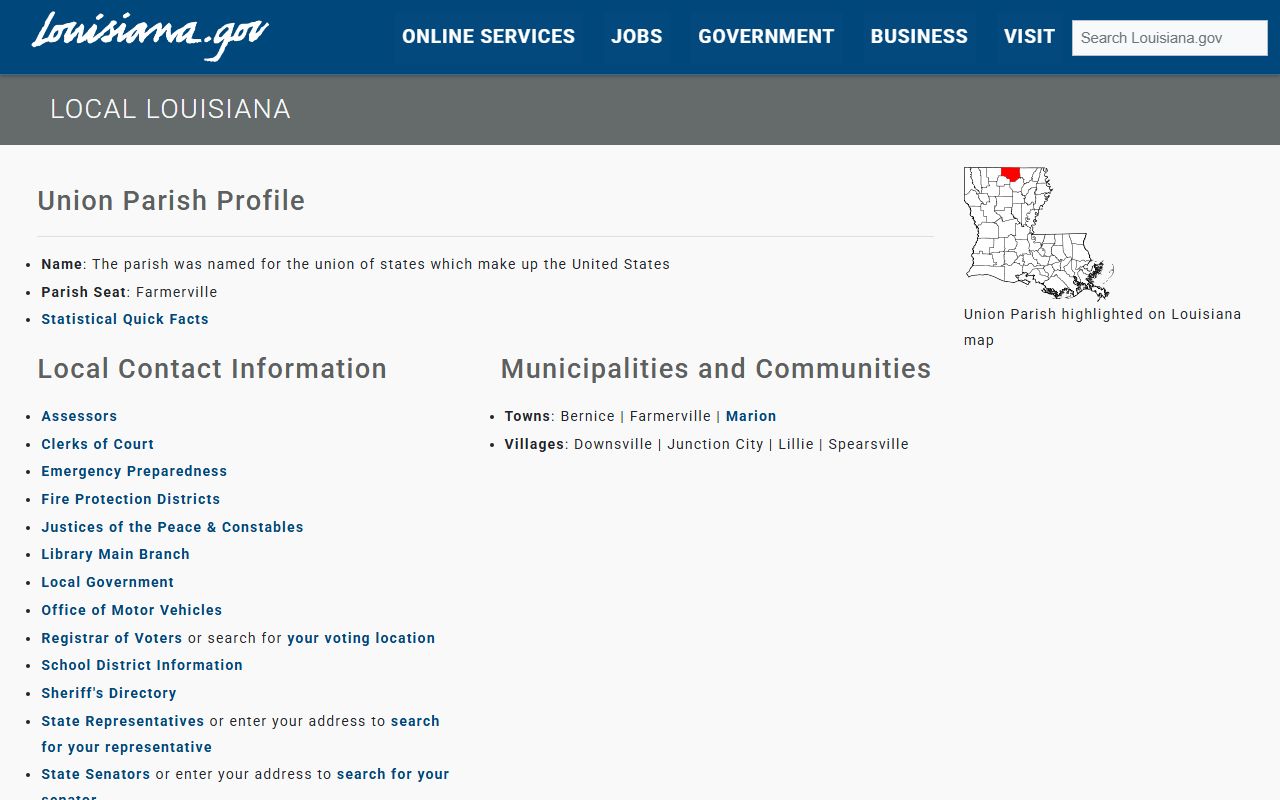
That local context supports routing municipal and parish-level questions to the correct public office.
Search Union Parish Traffic Records
The research did not capture a full citation search screen with every nCourt field, but it did confirm that the UPSO Civil Office page links online payment portals for fines and docket fees. For UPSO and Louisiana State Police citations issued in Union Parish, the Civil Office is the central payment channel. Online payment is a payment path, not a complete court-record database, so a paid ticket, court setting, or disputed citation may still require the issuing office, the court, or the clerk.
- Read the citation and identify whether it was issued by UPSO, Louisiana State Police, or a municipal agency.
- For UPSO or Louisiana State Police citations in Union Parish, use the UPSO Civil Office instructions.
- For Farmerville, Marion, Bernice, or Junction City citations, contact the issuing municipality or court.
- Confirm the fine amount before paying, especially if the citation is old or has a court date.
- If contesting, follow the court appearance or contact instructions rather than using payment as the only response.
- Keep the receipt, original citation copy, and any disposition or dismissal proof.
Union Parish Citation Fields
The citation and payment field table is based on the official Union Parish research. It is intentionally limited because the exact nCourt screen fields were not captured. The table still records the payment facts that matter most locally, including the original citation requirement for mailed payment and the cash-only in-person rule for citations.
| Field / item | Type | Required | Notes |
|---|---|---|---|
| Citation number | Text | Likely yes | Needed for payment or search; exact nCourt fields were not captured. |
| Defendant or driver name | Text | Likely yes | Used to identify the ticket. |
| Original citation | Paper document | Yes for mail | UPSO says the original citation must accompany mailed payment. |
| Payment type in person | Cash | Yes | Cash only during normal business hours for citations. |
| Payment type by mail | Money order or cashier's check | Yes | Personal checks are not accepted. |
| Online payment | Vendor portal | If paying online | Civil Office links nCourt for fines and docket fees. |
Union Parish Traffic Record Fields
A traffic court record is not the same thing as a payment screen. If the matter becomes part of a court file, the record may include the citation, charge, case number, court, payment status, disposition, and financial entries. If the citation is resolved through a local payment channel, the receipt may be the most important proof for the driver. If the matter becomes a criminal traffic or DWI case, the court file becomes more detailed.
| Field | What It Shows |
|---|---|
| Citation number | The ticket identifier used by the issuing agency or payment channel. |
| Issuing agency | Whether the ticket came from UPSO, Louisiana State Police, or a municipal source. |
| Charge or violation | The traffic offense or allegation listed on the citation. |
| Court or payment venue | The office or court that handles payment, contest, or case processing. |
| Fine, costs, or docket fees | Amounts due when confirmed by the correct office. |
| Disposition | Payment, dismissal, plea, conviction, continuance, or other court result if filed. |
| Crash report link | Separate sheriff records request channel if a crash report is needed. |
Union Parish Ticket Payment Methods
The Civil Office payment rules are specific. For UPSO and Louisiana State Police citations in Union Parish, in-person citation payments are cash only during normal business hours. Mail payments must be by money order or cashier's check, and the original citation must be included. Personal checks are not accepted. The Civil Office page also links online payment through nCourt for fines and docket fees.
| Payment route | Accepted method | Local limit |
|---|---|---|
| In person citation payment | Cash | For UPSO and Louisiana State Police citations handled by the Civil Office. |
| Mail citation payment | Money order or cashier's check | Original citation must accompany payment. |
| Online fines and docket fees | nCourt portal linked by Civil Office | Use the correct portal for the fine or docket-fee category. |
| Municipal citation payment | Not handled by UPSO | Farmerville, Marion, Bernice, and Junction City must be contacted separately. |
Note: Paying a citation can affect court status, license status, or conviction reporting, so confirm the effect before paying.
Contest Union Parish Traffic Tickets
A driver who wants to contest a Union Parish traffic ticket should not rely on payment instructions alone. The first step is to identify the issuing agency. UPSO and Louisiana State Police citations use the Civil Office path for payment, but a contest or court appearance may require the court listed on the citation. Municipal tickets from Farmerville, Marion, Bernice, or Junction City are outside the UPSO collection channel, so the issuing municipality or court should provide contest instructions.
- Read the citation for the issuing agency, court date, and payment or appearance instructions.
- Confirm whether payment is optional or whether a court appearance is required.
- Ask the correct office how to plead not guilty or request a hearing if contesting.
- Do not miss a court date or payment deadline, since that can create bench-warrant or license issues.
- Bring the citation, proof of insurance if relevant, receipts, repair proof, and any written court notice.
Traffic Court vs Driver Record
A Union Parish traffic court record and a Louisiana driver record are different files. The local court or payment record shows what happened to the citation or case. The state driver record shows license status, reportable convictions, suspensions, and administrative history maintained through state driver-record channels. Correcting one file does not always correct the other automatically.
| Record | Held by | Shows | Does not show |
|---|---|---|---|
| Court or citation record | UPSO Civil Office, municipal court, or Third JDC/Clerk depending on citation | Citation, charge, court or payment status, fines, docket fees, and disposition if filed | Complete statewide driving history |
| State driver record | Louisiana OMV or official state driver-record system | License status, reportable convictions, suspensions, and administrative status where applicable | Full court pleadings or clerk case file |
| Crash report | UPSO or state crash report channel | Accident report details | Court disposition unless tied to a citation |
Union Parish Traffic Fees
Fine amounts for citations should be confirmed with the Civil Office or the issuing municipality because the research did not provide a fine schedule by violation. The research did provide sheriff records fees that matter for traffic-adjacent requests, especially crash reports and related reports. Court costs, docket fees, and fines can be paid through Civil Office channels when that office handles the matter, but personal checks are not accepted for court costs by mail or in person.
| Item | Amount or rule |
|---|---|
| State crash report | $15 through sheriff records request channel. |
| Vehicle incident report | $10. |
| Other reports | $10. |
| Reports over five pages | $1 per page extra. |
| Printed photos or paper copies | $1 per page. |
| CDs or digital media | $10 each. |
Union Parish DWI and CDL
DWI and serious traffic offenses should be treated differently from routine citation payments. A DWI may move into the criminal court process, where charges, arraignment, motions, pleas, disposition, and sentencing are part of the criminal case record. Commercial driver's license issues can also carry consequences beyond the local fine, including reporting or license consequences that are not fully shown in a local court payment record.
For DWI or criminal traffic filings, use the court case path rather than only the citation payment channel. The full case file belongs with Union Parish criminal court records, while the traffic ticket channel answers payment and citation routing questions.
The U.S. Attorney's Office for the Western District of Louisiana is an assigned federal source for higher-level prosecutorial context.
Most local tickets will not be federal matters, but the source helps distinguish local citation records from federal criminal jurisdiction.
Union Parish Traffic Access Limits
Louisiana Public Records Law broadly defines public records and requires custodians to permit inspection and copying unless a legal exception applies. Traffic records still have limits. Juvenile records are confidential. Sealed or expunged criminal traffic records may be removed from public access. Personal identifiers, financial data, protected addresses, and minor names should be redacted from public copies. A crash report, a citation payment record, and a court file may also have different custodians.
Expungement and sealing are not automatic after payment. Louisiana expungement law removes eligible records from public access but does not necessarily destroy every agency copy. Eligibility depends on the charge, disposition, waiting period, prior record, and whether the case was dismissed, acquitted, set aside, or resulted in an eligible conviction. The Clerk of Court can accept filings, but the clerk does not give legal advice.